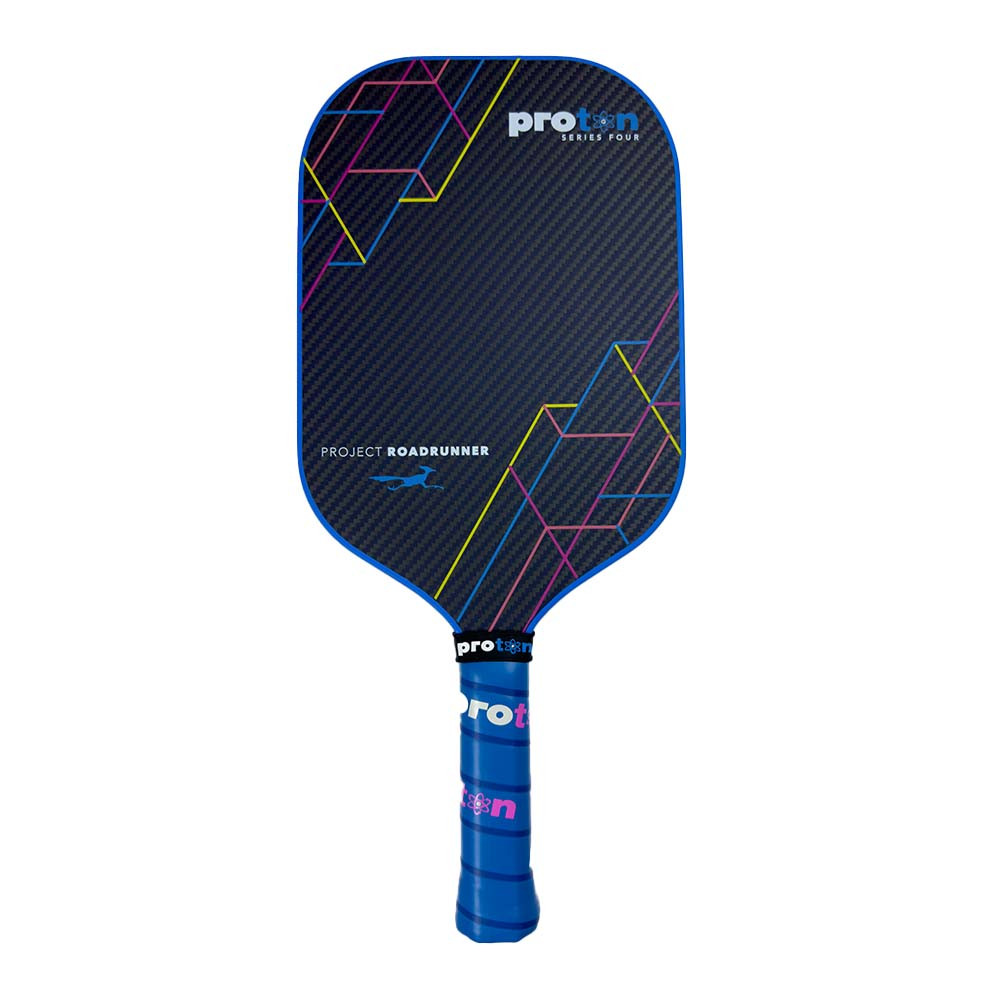
Front · Hitting face and graphics2/7 verified views
  • Front
  • Back
  • Edge guard view not yet published
    Edge guard
  • Handle view not yet published
    Handle
  • Surface texture view not yet published
    Surface texture
  • Side profile view not yet published
    Side profile
  • Size comparison view not yet published
    Size comparison

5 of 7 views are still being sourced from Proton. We only publish photography of this exact model, so empty slots stay empty until the real shot exists.

$175MSRP $175

As an Amazon Associate we earn from qualifying purchases. Prices and availability are checked periodically and can change.

Best spin durability

Proton

Proton Series Four (Project Roadrunner)

86Tested 2026-07-29 · Spin-first players who wear faces out

The exposed Kevlar weave is the story: it grips the ball like a fresh grit face but, unlike sprayed textures, it is the material itself, so the spin number does not decay over a season.

Cross-shopping? Most buyers weigh the Series Four (Project Roadrunner) against the Vatic Pro V-Sol Pro 16 see them side by side, or browse every Proton paddle.

Core
15 mm
Weight
7.9 oz
Swing wt
110
Twist wt
6.3
Shape
elongated
Surface
Aerospace bi-directional carbon with exposed aramid weave
Grip
5.375 in
Released
2026

Pros

  • Highest spin figure in the database
  • Edgeless build keeps swing weight at 110
  • Texture durability beats coated faces

Cons

  • 15 mm hybrid core has less plow-through than 16 mm rivals
  • Edgeless faces chip if you scrape the court

AI verdict — generated from measured specs

Last updated: July 2026

Should you buy the Series Four (Project Roadrunner)?

The Proton Series Four (Project Roadrunner) scores 85.6/100 on our IQ index, built from all 15 Paddle DNA traits. Its signature is spin (95/100, 98th percentile of the database), backed by maneuverability at 84 and consistency at 88. The 15 mm Nomex and polypropylene hybrid honeycomb core and Aerospace bi-directional carbon with exposed aramid weave face at 7.9 oz put it in the all-court — comfortable driving and resetting in the same rally bracket.

Where it gives ground is forgiveness (82) and sweet spot (84). With a 110 kg·cm² swing weight and a 5.375 in handle it suits intermediate/advanced/pro players, two-handed backhands, hands battles at the kitchen. Skip it if you specifically want the opposite profile — maximum pop and minimum dwell time.

Closest paddles by DNA: Vatic Pro V-Sol Pro 16 ($99), Selkirk SLK Halo XL Control ($100), Vatic Pro V7 Hybrid ($99). If budget matters, the Vatic Pro V-Sol Pro 16 lands within 0 IQ points for $76 less. Overall: a strong buy for the right player, though not the outright best paddle in the database.

Best for
intermediate/advanced/pro players, two-handed backhands, hands battles at the kitchen
Playing style
all-court — comfortable driving and resetting in the same rally
Avoid if
you specifically want the opposite profile — maximum pop and minimum dwell time

In depth

Proton Series Four (Project Roadrunner) — the long answer

Project Roadrunner posts the highest spin figure in the database (95) using exposed aramid fibre rather than a coating. Because the texture is the material, it does not wear smooth the way sprayed grit does.

The sections below are analysis of measured specifications and Paddle DNA™ values, not a play-test write-up. Where we have hit with a paddle, those notes appear separately and are attributed.

Why the spin lasts

Most high-spin faces rely on a texture applied over carbon. That layer polishes down over a season and the paddle quietly loses bite. Proton weaves aramid (Kevlar) into the surface itself, so the grip on the ball is structural. The practical effect is not a higher first-day spin number than the best raw-carbon faces — it is the same number twelve months later.

A 15 mm hybrid core at 110 swing weight

The Nomex and polypropylene hybrid core is thinner than the 16 mm standard, and the edgeless build keeps swing weight at 110 — light for a 16.5 in shape. That is where maneuverability 84 comes from, unusually high for this length. The cost is plow-through 78: against heavy hitters you supply more of the pace yourself.

Community consensus

What other players say about the Proton Series Four (Project Roadrunner)

Verbatim excerpts from public discussion and independent reviews, plus the themes they add up to. These are other people's opinions, not ours, and every quote links back to where it was written.

No sourced community excerpts are published for this paddle yet. We only quote text we can link back to.

Who should buy the Series Four (Project Roadrunner)?

  • Former tennis players and two-handed backhands
  • Soft-game specialists who reset and dink their way through rallies
  • Topspin-heavy players rolling and dipping every ball
  • Players who live in hands battles at the kitchen line
  • Brand-new beginners still finding a contact point

Series Four (Project Roadrunner) head-to-head comparisons

The matchups people actually cross-shop, each with a full 15-trait breakdown.

Paddle DNA™ — all 15 traits

Every trait normalised 0-100 against the full database, so these numbers mean the same thing on any paddle page. How we measure →

Power85Control88Spin95Forgiveness82Sweet spot84Stability83Maneuverability84Touch86

Key attributes

Power85
Control88
Spin95
Forgiveness82
Sweet spot84
Stability83
Maneuverability84
Pop82
Touch86
Consistency88
Swing weight68
Twist weight82
Launch angle57
Plow through78
Softness80

DNA match — paddles within 5% of the Series Four (Project Roadrunner)

Our similarity engine ranks the whole database by average DNA deviation. Tighten or widen the band to see how far you have to travel to save money or gain a trait.

Paddle DNA™ match

Match tolerance

Proton Series Four (Project Roadrunner)

IQ 85.6 · $175

Power85Control88Spin95Forgiveness82Sweet spot84Stability83Maneuverability84Touch86

8 paddles within 5% of the Series Four (Project Roadrunner)

Ranked by DNA deviation

  1. -6 spin+5 forgiveness-4 maneuverability+4 softness

    Saves $76 versus the Series Four (Project Roadrunner) · +5 forgiveness · -6 spin · Higher IQ score (85.8 vs 85.6)

  2. -6 spin-6 maneuverability-5 power-4 pop

    Saves $75 versus the Series Four (Project Roadrunner) · -6 spin

  3. -6 spin-6 maneuverability-5 touch-4 consistency

    Saves $76 versus the Series Four (Project Roadrunner) · -6 spin

  4. -8 maneuverability-7 spin-6 softness-4 touch

    Saves $15 versus the Series Four (Project Roadrunner) · -8 maneuverability

  5. -11 spin+6 forgiveness+6 softness+5 sweet spot

    +6 forgiveness · -11 spin · Higher IQ score (86.3 vs 85.6)

  6. -9 maneuverability-8 spin+8 swing weight+4 forgiveness

    +8 swing weight · -9 maneuverability

  7. +7 forgiveness+7 sweet spot+6 twist weight+5 stability

    +7 forgiveness · -4 maneuverability · Higher IQ score (87.6 vs 85.6)

  8. -17 spin-8 maneuverability-6 touch-6 consistency

    -17 spin

Best alternatives to the Series Four (Project Roadrunner)

Each pick beats the Series Four (Project Roadrunner) on one specific thing — price, power, control or forgiveness.

Similar paddles (within 8% DNA)

Want a different matchup? Compare any two paddles or browse the full paddle database.

Series Four (Project Roadrunner) — frequently asked questions

Does the exposed Kevlar wear out?
It abrades far more slowly than coated textures because the grit is the weave, not a layer over it. Court scrapes still damage any edgeless paddle.
Is it a control or power paddle?
Neither extreme. Control 88 and power 85 with an elongated shape make it an all-court spin paddle.
Edgeless — is that a durability problem?
Only if you scrape the paddle on the court. Edgeless builds add face area and swing speed but have no sacrificial bumper.
Is the Proton Series Four (Project Roadrunner) good for beginners?
Not our first recommendation. Forgiveness sits at 82/100 and the paddle is tuned for intermediate/advanced/pro play. A developing player is better served by something more forgiving and cheaper — see our beginner shortlist.
Is the Proton Series Four (Project Roadrunner) worth the price?
At $175 it sits in the 37th percentile of the database for cost and the 57th for IQ score. If those numbers do not line up for you, the Vatic Pro V-Sol Pro 16 at $99 is the value alternative we point people to.
How does the Series Four (Project Roadrunner) compare to the V-Sol Pro 16?
They are close on DNA. The Series Four (Project Roadrunner) reads power 85 / control 88 / spin 95 against 84 / 90 / 89 for the V-Sol Pro 16, at $175 versus $99. Our full head-to-head breaks down every trait.
Is the 15 mm better than the 16 mm version?
A 14 mm core returns energy faster, so drives and speed-ups come off harder with less effort. The 16 mm build gives up some of that pop for dwell time and softer hands. Pick 14 mm for pace, 16 mm for touch.
Is the Proton Series Four (Project Roadrunner) approved for tournament play?
Sanctioned play requires the model to appear on USA Pickleball's official approved-equipment list. Proton submits its retail models for approval, but approval is per model and configuration, so check the current USAP list for the exact Series Four (Project Roadrunner) build before you enter a sanctioned event. We do not list approval status we have not verified.
Does the Series Four (Project Roadrunner) have good spin?
Spin measures 95/100 — the 98th percentile of our database — off a Aerospace bi-directional carbon with exposed aramid weave face. That is top-tier: enough bite for heavy topspin drives and rolls.
Is the Series Four (Project Roadrunner) head heavy?
Swing weight is 110 kg·cm² and twist weight 6.3. That is light and fast through the swing path, which favours hands battles over plow-through. Static weight is 7.9 oz.
Does the Series Four (Project Roadrunner) benefit from lead tape?
Yes — at 110 kg·cm² there is room to add. Tape at 3 and 9 o'clock raises twist weight and stability with the smallest hit to hand speed; tape at 12 adds power and plow-through but slows the paddle noticeably. Any added weight can affect tournament legality if it changes the paddle beyond the approved configuration.
What is the best overgrip for the Series Four (Project Roadrunner)?
The stock handle is 5.375 in long with a 4.25 in circumference. A thin tacky overgrip adds roughly 1/16 in of circumference and a few grams above the balance point — the cheapest way to fine-tune fit. If your hand is larger than the 4.25 in stock size, build up with an under-wrap first rather than stacking overgrips.
What should I replace the Series Four (Project Roadrunner) with when it wears out?
Face wear shows up as lost spin long before the core dies. The straight replacement is another Series Four (Project Roadrunner); if you want to change something, the JOOLA Perseus Pro V 16 adds control (96 vs 88) and the Selkirk Labs Project Boomstik Elongated 16 adds power (95 vs 85).
Who is the Series Four (Project Roadrunner) best for?
Spin-first players who wear faces out. Skill levels we would put on it: intermediate, advanced, pro. Handle length of 5.375 in supports a two-handed backhand.
What shape and size is the Series Four (Project Roadrunner)?
elongated shape, 16.5 in long by 7.375 in wide, 15 mm Nomex and polypropylene hybrid honeycomb core, Aerospace bi-directional carbon with exposed aramid weave face, 7.9 oz. Released 2026.
Series Four (Project Roadrunner) on video

PickleballLookup review — coming soon
Head-to-head comparison — coming soon
Manufacturer footage — coming soon

Reviewed by

Alex Zubarev

Founder, PickleballLookup

Alex built the Paddle DNA™ database behind PickleballLookup — 15 normalized traits measured against every paddle in the catalog. Every page on this site is generated from that data and editorially reviewed before publication.

  • Paddle research
  • Equipment analysis
  • Player matching

Last updated July 2026 · How we score paddles