Paddle marketing talks about face material, generation numbers and pro endorsements. None of those decide whether a paddle helps a new player. Four measurable things do: weight, core thickness, shape and handle length. Get those right and almost any paddle in the $90–$150 band will work.
What weight pickleball paddle should a beginner use?
Start between 7.8 and 8.3 oz. That is not an arbitrary band — it is where you stop fighting two opposite problems. Below about 7.8 oz the paddle has too little mass behind the ball, so a hard drive pushes the face back and your reset floats; you compensate by swinging harder, which is how beginners start missing long. Above roughly 8.4 oz your hands get late in kitchen exchanges and elbow load climbs, which is the most common cause of pickleball elbow in a player's first year.
The number that actually predicts how a paddle feels mid-rally is swing weight, not static weight. Swing weight measures how the mass is distributed away from your hand. Two 8.0 oz paddles can feel completely different if one carries its weight at the tip. For a first paddle, look for 110–116 kg·cm²; every paddle in our table lists its figure.
A practical tip: you can always add weight, but you cannot remove it. Lead tape on the edge guard at 3 and 9 o'clock adds stability; at 12 o'clock it adds power. Buying light and adding a few grams is the cheap way to find your number.
Lighter options: Vatic Pro Atlas 16, Vatic Pro V-Sol Pro 16, JOOLA Essentials 16. Heavier, more stable: Six Zero Double Black Diamond Control, Selkirk Vanguard 2.0 Invikta, Vatic Pro Oni 16.
14mm vs 16mm: which core thickness for a beginner?
Choose 16 mm. Core thickness is the single biggest contributor to how forgiving a paddle feels, and it is the spec most beginners get wrong because thin paddles are marketed as “faster.”
A thicker polymer core compresses more on impact and holds the ball on the face fractionally longer. That extra dwell time does three things a new player needs: it damps the energy of a hard incoming ball so resets drop short instead of popping up, it widens the area of the face that produces a playable ball, and it softens the shock that reaches your elbow. A 14 mm core returns energy faster — more pop, more put-away power — but it punishes contact away from centre and makes the soft game genuinely harder.
The trade is real but lopsided at this level. You lose a little power you cannot reliably use yet, and you gain forgiveness on the mishits you are definitely still making. Move to 14 mm when you are winning hands battles and your drops are consistent — usually somewhere around 3.5.
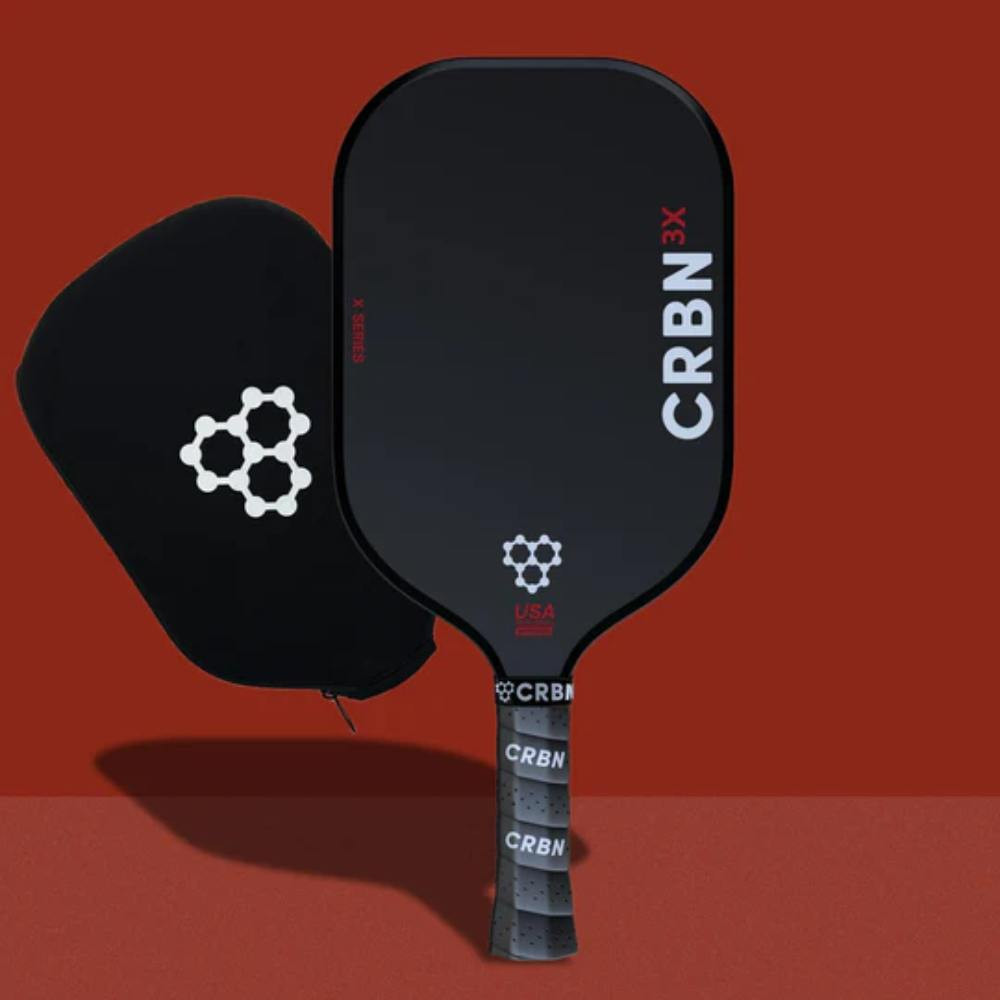
16 mm picks: Six Zero Double Black Diamond Control, Selkirk SLK Halo Control, CRBN-3X Power Series. Thin-core paddles for later: JOOLA Scorpeus 14, Ronbus R4 Pulsar, Selkirk Labs Project 007 Epic 14.
Standard vs elongated shape
Every paddle is capped at 24 in of combined length and width, so shape is a zero-sum choice. A standard (or widebody) face is roughly 16 × 8 in: shorter, wider, with the sweet spot sitting low and central — right where a new player's contact point naturally lands. An elongated face is roughly 16.5 × 7.5 in: it buys reach and leverage on drives, moves the sweet spot up toward the tip, and narrows it.
For most beginners, standard wins. The extra half inch of reach is worth far less than the wider forgiving area, and elongated paddles have higher swing weight, which slows your hands at the line.
The exception is tennis and platform tennis converts. If you already have a grooved swing path and a two-handed backhand, an elongated face with a 5.5 in handle will feel like home — the longer handle is the real benefit, since anything under 5.25 in forces your bottom hand onto the face bevel. Hybrid shapes split the difference and are a reasonable hedge.
Standard/widebody: Six Zero Double Black Diamond Control, Vatic Pro Atlas 16, JOOLA Essentials 16. Elongated: CRBN-3X Power Series, Ronbus Nova R1, Selkirk Vanguard 2.0 Invikta.
Face material, grip and price
Face: fiberglass is livelier and cheaper; raw carbon (T700 or toray) grips the ball for spin and keeps its texture longer. Both are fine to learn on. What to avoid is a smooth graphite composite that has already lost its grit — spin comes from surface texture, and texture wears out.
Grip: measure before you buy. A 4.25 in circumference suits most adult hands. If you are between sizes, buy the smaller one and build it up with an overgrip — you can add, you cannot subtract, and a grip that is too large is a common cause of wrist and elbow pain. Handle length matters more than circumference for two-handed backhands: 5.25 in is the practical minimum, 5.5 in is comfortable.
Price: $90–$150 is the sweet spot. Below about $60 you get thin cores, dead faces and grips that need replacing immediately. Above $150 you pay for power and spin ceilings that a beginner's contact consistency cannot reach — the paddle is not the limiting factor yet. Of the 130 paddles in our database, 18 come in under $100, and several of them measure better on forgiveness than paddles at twice the price.
USAP approval: if you might ever play a sanctioned tournament, check the paddle is on the USA Pickleball approved list. Every paddle recommended here is.
 #1 Best overall