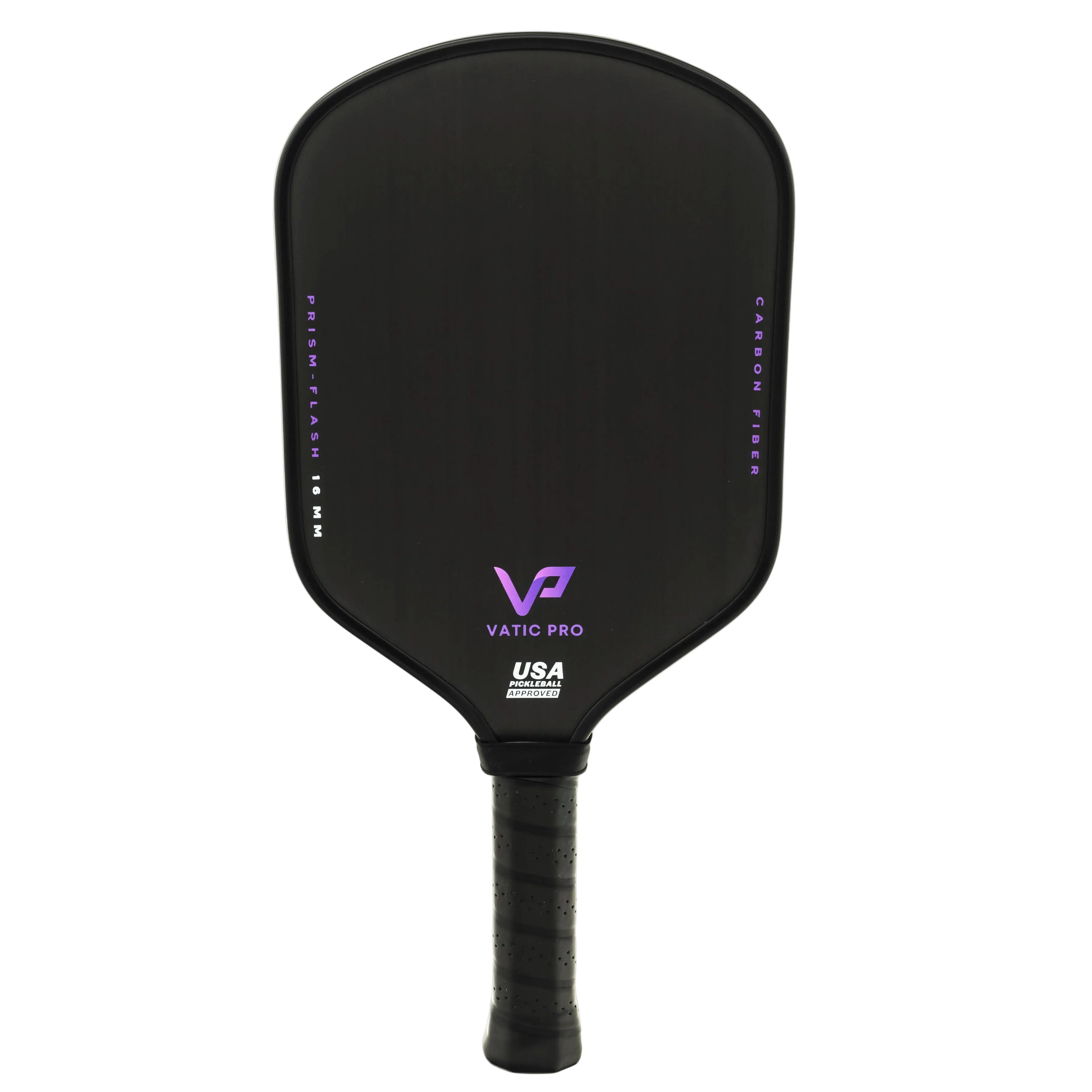
- Is the Vatic Pro V7 worth it?
- It is the strongest published value in the database. Thermoformed feel, spin 89 and a balanced profile at $99 give up very little to paddles at twice the price on center contact.
- Vatic Pro V7 vs Prism Flash?
- The V7 is the hybrid: more power (82 vs 71), more stability, thermoformed. The Prism Flash is elongated, lighter through the swing (109 vs 113) and $25 cheaper. Take the V7 unless you specifically want reach and quick hands.
- Is it good enough for tournament play?
- On spec-derived traits, yes for 3.5-4.5 level. The gap to premium paddles shows up in off-center forgiveness, not in what the paddle does when you hit it clean.
- Is the Vatic Pro V7 Hybrid good for beginners?
- Not our first recommendation. Forgiveness sits at 83/100 and the paddle is tuned for intermediate/advanced play. A developing player is better served by something more forgiving and cheaper — see our beginner shortlist.
- Is the Vatic Pro V7 Hybrid worth the price?
- At $99 it sits in the 10th percentile of the database for cost and the 40th for IQ score. If those numbers do not line up for you, the Vatic Pro Prism Flash at $74 is the value alternative we point people to.
- How does the V7 Hybrid compare to the SLK Halo XL Control?
- They are close on DNA. The V7 Hybrid reads power 82 / control 85 / spin 89 against 80 / 88 / 89 for the SLK Halo XL Control, at $99 versus $100. Our full head-to-head breaks down every trait.
- Is the 16 mm better than the 14 mm version?
- A 16 mm core has longer dwell time, which is what produces softer resets and more repeatable placement. The 14 mm build trades that dwell for a faster, poppier response off the face. Control players take 16 mm; players who want the ball gone quickly take 14 mm.
- Is the Vatic Pro V7 Hybrid approved for tournament play?
- Sanctioned play requires the model to appear on USA Pickleball's official approved-equipment list. Vatic Pro submits its retail models for approval, but approval is per model and configuration, so check the current USAP list for the exact V7 Hybrid build before you enter a sanctioned event. We do not list approval status we have not verified.
- Does the V7 Hybrid have good spin?
- Spin scores 89/100 — the 52nd percentile of our database (around the database average) — off a Raw T700 carbon face. Spin is not this paddle's strength — several paddles in the same price band score meaningfully higher.
- Is the V7 Hybrid head heavy?
- Swing weight is 113 kg·cm² and twist weight 6.3. That is mid-range: balanced enough that most players will not describe it as head heavy. Static weight is 8.1 oz.
- Does the V7 Hybrid benefit from lead tape?
- Yes — at 113 kg·cm² there is room to add. Tape at 3 and 9 o'clock raises twist weight and stability with the smallest hit to hand speed; tape at 12 adds power and plow-through but slows the paddle noticeably. Any added weight can affect tournament legality if it changes the paddle beyond the approved configuration.
- What is the best overgrip for the V7 Hybrid?
- The stock handle is 5.3 in long with a 4.25 in circumference. A thin tacky overgrip adds roughly 1/16 in of circumference and a few grams above the balance point — the cheapest way to fine-tune fit. If your hand is larger than the 4.25 in stock size, build up with an under-wrap first rather than stacking overgrips.
- What should I replace the V7 Hybrid with when it wears out?
- Face wear shows up as lost spin long before the core dies. The straight replacement is another V7 Hybrid; if you want to change something, the JOOLA Perseus Pro V 16 adds control (96 vs 85) and the Selkirk Labs Project Boomstik Elongated 16 adds power (95 vs 82).
- Who is the V7 Hybrid best for?
- Improving players on a budget. Skill levels we would put on it: intermediate, advanced. Handle length of 5.3 in supports a two-handed backhand.
- What shape and size is the V7 Hybrid?
- hybrid shape, 16.2 in long by 7.7 in wide, 16 mm Thermoformed polymer core, Raw T700 carbon face, 8.1 oz. Released 2026.